Part I
Motivation & Concepts
Fundamental knowledge and core hypotheses.
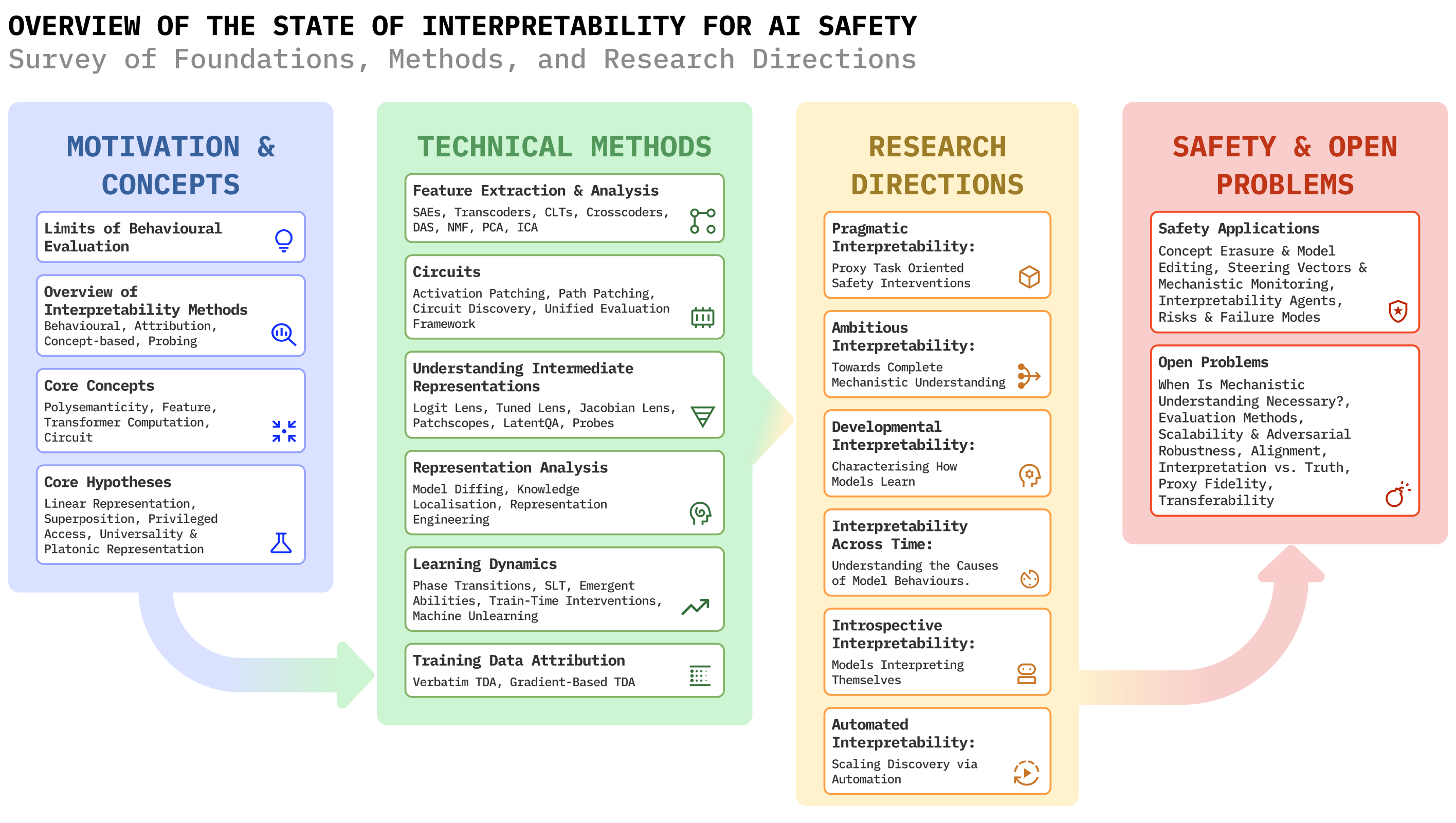
Limits of Behavioural Evaluation · Overview of Interpretability Methods · Core Concepts · Core Hypotheses
Does understanding how models work actually make them safer?
Read the handbookCode and notebooksPaper (arXiv)PDFalphaXivCite
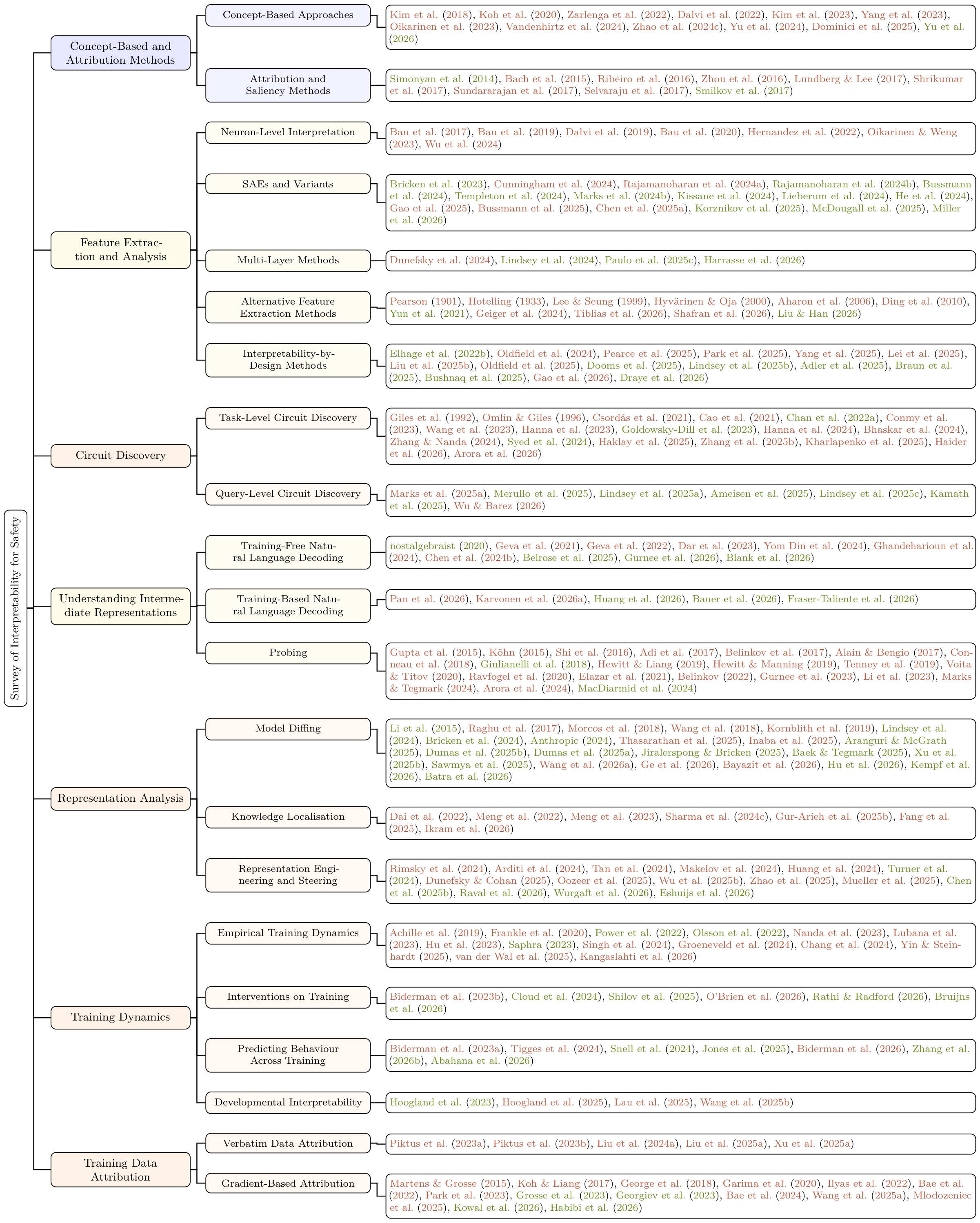
We survey interpretability for AI safety, focusing on mechanistic interpretability (MI)—the study of neural networks’ internal representations and computations to develop causal understanding and support targeted interventions. We first situate MI within the broader interpretability landscape, contrasting its mechanism-level evidence with behavioural evaluation while emphasising how behavioural, attributional, and representation-based methods can complement mechanistic analysis. We introduce core foundations for MI from first principles, including features, polysemanticity, superposition, transformer computation, and circuits, and survey methods for feature extraction and analysis, circuit discovery and causal verification, interpreting intermediate representations, training-data attribution, learning dynamics, knowledge localisation, and representation steering. We then characterise six research orientations—Pragmatic, Ambitious, Developmental, Interpretability Across Time, Introspective, and Automated Interpretability—as agendas defined by their goals, assumptions, and trade-offs rather than by exclusive method sets. Finally, we examine how mechanistic understanding can support safety interventions, including knowledge editing, steering, monitoring, and automated interpretability agents, while assessing their limitations, failure modes, open problems, and relationship to behavioural safety measures.
Fundamental knowledge and core hypotheses.
Limits of Behavioural Evaluation · Overview of Interpretability Methods · Core Concepts · Core Hypotheses
Approaches developed and used in interpretability research.
Feature Extraction & Analysis · Circuits · Understanding Intermediate Representations · Representation Analysis · Learning Dynamics · Training Data Attribution
Six research orientations, characterised by their goals, assumptions, and trade-offs.
Pragmatic Interpretability · Ambitious Interpretability · Developmental Interpretability · Interpretability Across Time · Introspective Interpretability · Automated Interpretability
Deployment-oriented interventions and the critical challenges that remain.
Safety Applications · Open Problems
The handbook The full survey, by chapter.
Methods explorer The methods in the survey, side by side.
Evaluation framework Five dimensions for evaluating interpretability claims.
Research orientations Six research agendas and their trade-offs.
Safety and open problems Safety applications and open problems.
Experiments Superposition, sparse autoencoders and activation patching.
Notebooks 19 companion notebooks.
arXiv: 2611.08438 · alphaXiv
@misc{barez2026understandingaiinsidestate,
      title={Understanding AI from the Inside: The State of Mechanistic Interpretability for AI Safety},
      author={Fazl Barez and Tung-Yu Wu and Hunar Batra and Gabriele Dominici and Florent Draye and Yanai Elazar and Damiano Fornasiere and Antía García and Abir Harrasse and Riley Harris and Sara Hooker and Michael Lan and Belinda Z. Li and Aaron Maiwald and Narmeen Fatimah Oozeer and Naomi Saphra and Or David Shafran and Adi Simhi and Robert Trager and Shriyash Kaustubh Upadhyay and Ziyu Yao and Yu Zhao and Shay B. Cohen and Mor Geva and Yoshua Bengio and Stella Biderman and Hassan Sajjad},
      year={2026},
      eprint={2611.08438},
      archivePrefix={arXiv},
      primaryClass={cs.CL},
      url={https://arxiv.org/abs/2611.08438},
}